So, amidst my vacation and LJ's general asshattery, I learned the rather sad news that Amy Winehouse, an artist I was exceedingly fond of, passed away at the alarmingly young age of 27. A lot of people have said a lot of things about her, and they're entitled to their opinion.
I first heard of her around the same time almost everyone I know did, when people started linking to her video of "Rehab" around the time Britney Spears had her bald-headed freakout and got shipped off for her first of many involuntary psychiatric holds. I liked the song immediately - it was sharp, it was funky, the lyrics were clever, and it had horns, which is a major musical weakness of mine. I love me some brass and woodwinds on a track.
New Orleans Girl had just started working with me around that time, and I asked if she'd heard of it. She's generally way ahead of the curve music-wise, and already had the album in her possession. We listened to it at work a lot, so much that I got my own copy as soon as I could. It's a fantastic, fantastic collection of songs, with Amy growling over a whirlwind of moaning horns, thumping bass and drums and dirty guitar. I can't lie - the songs "You Know I'm No Good" and "Back to Black" would send me back to the repeat button far more than some of the others, but I loved every bit of that album. And when New Orleans Girl introduced me to "Valerie", I went nuts. It was a perfect combination of vocal and instrumental, produced beautifully, and what I point to first when explaining why Mark Ronson is one of the best producers around today.
I tried not to pay too much attention to the train wreck that Amy's life started to become after awhile. I just wanted her butt back in the studio, writing and releasing new songs. (Preferably good ones). I discovered other, similar artists that I came to really enjoy as well - Sharon Jones & the Dap Kings, Adele, Kate Nash...but I still hoped that Amy was going to record another amazing record and blow everyone away.
Instead Adele did that (What, you haven't listened to 21 yet? GO. IMMEDIATELY.) and Amy died. :/
I realized today that despite New Orleans Girl's urging, I never listened to "Frank", Amy's debut. She'd said it was more "Erikah Badu-esque", and I kind of shrugged it off, as I much preferred the post-apocalyptic Ronnie Spector vibe she had on "Back to Black." But after learning that there would be no more albums, I finally cued it up on Spotify (a new toy I'm still learning how to use) and had a listen.
Now I am truly sad. The music is funky and jazzy - combining bebop swing with hip hop bounce seamlessly. And the lyrics are equally good - as sharp and funny as anything on Back to Black, if not better.
I wish she'd put more tracks down in the studio than tracks in her arm. I really do. It's a fucking waste that we lost someone with so much potential, and I feel that way someone young and promising meets and untimely end, especially when it's due to addiction. It's so unfair.
One song I heard on Frank just now sent chills up my spine. It's called "October Song," and looking back with 20-20 vision, let's just say it's a little prescient. Look that up, check it out. Check her out - she's more than a punchline, she's a great voice that we lost. And that's a fucking sad thing.
We're going to have so much fucking fun, we're going to need plastic surgery to remove our smiles!!
The last few times I've taken time off of work, even with J, they've largely been staycations. Aside from some NYC-based activity (which is no slouch, really), we've largely stayed home, much to the derision and consternation of others (despite our own satisfaction with it). So, when J informed me that he had some days to take off coming up, wheels began to turn, and we decided that it was high time we Went Somewhere.
See, J's family owns a lovely three-bedroom, two bath 18th Century farmhouse in the Hudson Valley region. For the unfamiliar, that's nestled between the capitol region in Albany and my hometown of NYC. It's about 2.5 hours by car, also somewhat accessible via train, and full of green and scenic scenery. Naturally, the house has been well-decorated and appointed by J's folks, combining mid-century touches with many of the original details of the house, making for a really impressive mix. We asked if we could possibly have it for a long weekend in July, and his folks were happy to oblige. I made arrangements with a rental car, and we even invited some friends up for part of it. I was definitely excited - I love the area, and this was going to afford us some opportunity to spend time up there to both relax and go do things, in addition to maybe a tiny bit of wedding-related recon.
The rental car was retrieved from Enterprise on Thursday morning. I was excited, because I had an upgrade coupon and we got everything together to get on the road nice and early. After some mild Manhattan traffic, we made good time and got upstate around noon. That's when the fun really started.
We arrived, turned on the house's central a/c unit, and set about unpacking and settling in. It seemed to take awhile for the a/c to cool off the house, if only to me. Now, I grew up in what some might consider dubious conditions - my house had neither a dishwasher nor central air conditioning. Mind you, we had sponges and window a/c units, so we all muddled through somehow. Anyway, we headed out for some lunch at really amazing local place called The Wild Hive and to pick up some provisions at A&P and cash at our respective ATMs. When we got home a few hours later, it became patently obvious that something was amiss. The house was still not showing evidence that the a/c was working, despite the fact that it was on high. (And with the exceptionally hot weather last week, ac was kind of crucial). We called J's folks, who called their local HVAC people, who said they'd come by Friday morning to see what was up. We had a nice dinner at a local (and delicious) BBQ joint, then came home and crashed early.
Friday J woke up to do some watering in his mom's extensive garden. When he went downstairs to head outside, I heard cursing. Turns out, there was a grapefruit-sized bulge in the ceiling that was leaking water. We scrambled and found a water-catcher, and called his folks yet again to inform them. Luckily, the HVAC people are also all-purpose handy-people, so they would be able to deal with this). Eventually, the colorful locals who run the HVAC company informed us of the following:
- The central air unit was fine, it's just that the house was hot, the weather extreme, it's an old building... (Riiight. Yet my hotel in August in Las Vegas in stupidly hot temperatures managed to get the rooms down to a chilly 60 degrees with no problem. WTF.)
- The leak was caused by the pipe that led to the shower head in the master bathroom upstairs. So we couldn't use the big bathroom to shower, we could only use the small shower on the first floor. They'd be back Monday to fix it. Greaaat.
(I'm not saying they weren't super entertaining. We heard some great stories, and they were pretty damn funny. But still. #$@%@#%)
We showered and headed out to Kingston (about 40 minutes away) to investigate wedding hotels. I learned a lot and felt like I made some good decisions regarding hotels to block for the wedding. We also had extra time between dinner plans with my friend Rob and his awesome gf Wendy, so we even saw Harry Potter. (Which was amazeballs). While wandering around the area (full of every chain restaurant and big box store in the known universe), we got a call from J's mom saying that she'd gotten a call from the alarm company that the power went out at the house. Thankfully, we were far away at that moment and not returning home until later, so we weren't worried, and we heard a couple of hours later that the power was back on, so no big. Friday passed without major incident, only including us getting lost on the way to meet our friends for an awesome dinner, which freaked me out. See, I'm a city girl to the nth power. I like cities, I feel comfortable there. Put me in the middle of a rural-ish area that I don't know and utter the phrase "I'm not sure where we are"? Hello, panic attack. Still, we got there, and more importantly, home, with no problem. The house wasn't too warm when we got back, either. So we came home, did a few things, then went to sleep.
Saturday was the big day of the weekend, as we were expecting four of our friends up, *our* first guests at the farmhouse. I was a little concerned about the house being warm in the morning, but didn't really concern myself with it too much. We had a really nice day with everyone despite the oppressive heat, and then when J took two of them back to the train, I hung out and played a fun card game called Fluxx with the two friends of ours who were crashing in the 2nd bedroom for the night. To our dismay, the house was extremely warm when we returned, and after a few hours, it became plainly obvious that the a/c had shit the bed and we were going to have to go without. Somehow, we managed through the hot, miserable night to endure, but it was the opposite of fun. I do have to extend my thanks to our overnight guests for their grace and good humor in a really crappy situation.
J called his folks in the morning after our guests had left and it was decided that we would head down to their Westchester house for the night when it became plainly obvious that no one would be able to come to look at the a/c unit before Monday, and we couldn't deal with another hot night. So we packed and headed out, a full day earlier than planned, but that's life in the country, I guess. We got down to his folks', had an incredible dinner cooked by J's dad (seriously one of the best meals of the weekend) and were settling in for the evening when I'd realized I'd left a bag I needed in the car.
The battery of the car was dead. Awesome. Because experience has taught me to always get full coverage, I called the roadside assistance people for a jump, and that's when our adventure really began.
The roadside guy made all sorts of upset faces at the sounds our car was making, and after performing a few tests, declared to us that the car had no oil in the engine. Now, I'm not exactly a pep boy, but I know that oil is pretty fucking important to a car's engine. He said that the car was not safe to drive and that we should call Enterprise for a replacement in the morning.
Thus really began our odyssey.
Me: Uh, hi. The car you gave me? It's borked.
Call to Enterprise Brooklyn: "Oh, they're just telling you that to get more money out of you."
Me: [redacted rage]
Them: "Uh, okay, you can call the office in the next town for a replacement."
The guys in the next town were super-helpful, especially after J's dad called and dropped his name, considering they see lots of business from him. They just had to wait for a car that they could give us. And the tow truck to come and get the broken car. After that half a day went by, we were FINALLY on the damn way back home, in the pouring, torrential rain.
There were wrong turns, and we didn't even have time to stop home first to drop off our stuff if we wanted to get the car back in time.
BUT - in a save worthy of Mariano Rivera, the super-apologetic Enterprise Brooklyn branch manager credited us a day on the rental and paid for our cab home. And he was wise to do so, as it prevented me from opening up the epic can of whoop ass I was prepared to launch at them. But after he explained that the employee who told me to drive the car anyway had been straightened out, and was extremely sorry for any inconvenience I was caused. Okay then. Eventually, we were home. And we'd survived.
I'm not saying there weren't highlights, there definitely were. But on the whole, this was a vacation worthy of the Griswold family. And as such, I leave you all with this song, which kept popping into my head over the course of the weekend as things just grew more and more ridiculous. As my dad said, "Times like that, you have to laugh. There's nothing else to do."
Back to work tomorrow. Hopefully that will be smoother than my time away from the office. :/
I inherited a few items from my Uncle Charlie. His 1930's vintage bedroom furniture (bought when it was new), some binoculars, many photographs, and a stapler. There's probably more than that, along with a large sheaf of memories, but right now, I'm only thinking about the stapler.
I know it sounds odd that the stapler is the thing I treasure most of all. It's a Swingline, probably from the late 1960's or early 1970's, procured when he was working in the mailroom/supply area of a company who shares the name with a seafaring adventurer from novels about the Napoleaonic wars. It hung around the house for ages before my parents told me I could keep it, I don't remember if it was before my uncle died or after.
I don't know what attracted me to it. It might have been the color (all other staplers I'd seen were black), the weight and heft of it (I might be able to use it as a weapon), or even the satisfyingly loud click it would make when I'd press down on the handle to staple something. It might have even been, back in my days as a fledgeling zinester, a brand name I'd internalized as being optimal in stapling. There were battles on the old yahoo zinesters list about what staplers were best; ask any zinester past or present about office supplies and be prepared to get comfortable - it won't be a short conversation. I learned more about office supplies and copy machines from talking to other zinesters than I ever did working in an office, but that's a topic unto itself.
I used that stapler to bind together pages for countless school reports. It even came with me to college, the first witness to any A's or B's I got. If I got homesick, I could look down at my uncle's name taped to the handle and feel a little closer to home. That stapler is probably why I insisted on a heavy, solid Swingline at work when the one I'd been given previously broke (no surprise there - staplers shouldn't be plastic). I always find them to be the best thing to hold pieces of paper together. Paper clips are a good temporary solution, but they tend to snag either on each other or pieces of paper that don't belong. Binder clips are find for things that are too big for a stapler, but for anything a stapler can hold together, I find them excessive. I still enjoy picking up the heavy stapler, pushing down on it to bind the pages, and hearing the click. My inner six-year-old beams with pride that I can now use one hand, instead of having to push down with all my might with both hands.
I know most people don't care about staplers as much as I do. Still, I'm always mystified when I get a pile of collated, but unstapled sheets of paper. Why collate, but not staple? Why just leave it all in one pile, without distinction? Seems like a waste to me. As much of a waste as writing several paragraphs about a stapler, I guess.
Back in July, the brain trust at Marie Claire, a publication I once considered to be of above-average intelligence for a fashion magazine, posted an article that I took considerable exception to. The gist of the essay was that there were women out there who were cold, calculating automatons who felt no need to be connected to other people - and what a fantastic step forward this was for women everywhere. I had some spare time on my hands since I was recovering from a minor medical procedure, so I composed and sent an angry letter to the editor:
This is what I sent:
Dear Ms. Coles:
I have been an avid reader (and paying subscriber) of Marie Claire since the magazine's redesign. I often recommend this title to friends, many of whom were looking for new reading material after the demise of Jane, lauding MC's ability to combine fashion & beauty with insightful articles.
However,I am inclined to retract my praise after Theresa O'Rourke's essay inthe August 2007 issue, "I, Fembot." While I share her distaste for hand-wringing and general over-sharing of emotion, I disagree with her assertion that being a caring, empathetic woman (or person) precludes being a strong, powerful, or successful one.
Moreover, I am astonished and appalled at the usually razor-sharp editors of Marie Claire for allowing this extremely ill-researched piece to be published without more careful review. It's obvious that no one on your staff had any idea what a fembot was before this piece went to press.
Fembots are possibly among some of the most unfeminist characters ever created. Though they were first seen in the farcical comedy Austin Powers, it does not change the darker reality of these characters. A fembot is an android created for either sexual gratification purposes or for use as an assassin. They are entirely controlled by men; brainless, as well as heartless, and not at all feminist. The remainder of your "proto-fembot" references are equally disturbing. The anonymous Vodka-ad robot, the ruthless,murderous machines of Terminator 3 and Metropolis and the servile Rosie are all unsettling ideals for any woman to be confronted with, but when combined with characters like the Bionic Woman and Seven of Nine, I have to object. First of all, the woman in the photograph is not Jamie Summers, but an entirely different character who appeared on a single episode of the show. Secondly, Jamie Summers merely received an enhanced ear, arm and legs, and endured no alterations to her personality whatsoever, as her inclusion with this grouping may suggest. Futher, as any regular viewer of Star Trek: Voyagercould tell you, Seven of Nine spent her seasons on the show endeavoring to distance herself from her cold, Borg programming and become a warmer, more connected human being.
Most of all, I find the very suggestion that the Stepford Wives are a step forward for women is a smack in the face. Anyone familiar with any version of Ira Levin's terrifying tale of suburban life and the suffication of self knows that a Stepford wife is something to fear and dread, and not to celebrate and emulate.
I sympathize with Ms. O'Rourke's struggle with dissociative impulses and what sounds very much like borderline personality disorder, but to suggest that this is a positive life choice for any human being (male or female) is irresponsible and completely wrongheaded. As any of the women in your photo spread would tell you (after recovering from the insult of being referred to as a "fembot") it is entirely possible to be both assertiveand caring – no batteries required.
All people need space, but one hardly needs to be a robotic, soulless icequeen in order to achieve this. For a magazine who constantly implores its readers to care more about the world around them (as well as their loved ones and selves), this seems to be a somewhat contradictory viewpoint. I doubt that O'Rourke's so-called fembot would give a second though to the plight of India's surrogate mothers, the crisis in Darfur, the war in the Middle East, or the environment, or anything but her own passing, superficial fancies. Am I to assume that such a self-absorbed individual is something to emulate? I certainly hope not.
I am deeply disappointed in your magazine for espousing these views. If you continue to do so, I might have to rethink my view of Marie Claire as a quality publication for intelligent, independent women.
Thank you for your time.
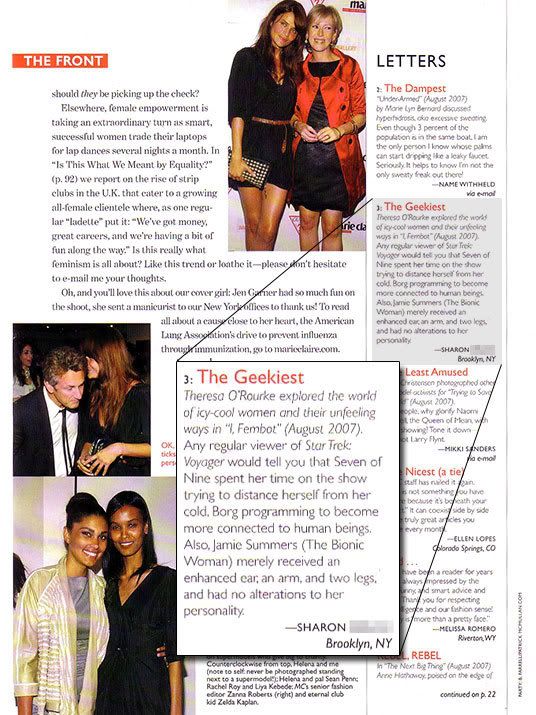
My friend Jessica imed me tonight to inform me that Marie Claire printed my letter in this issue! This is what they printed: (big thanks to Jessica for the scan and huge thanks to the multitalented Ryan Eanes for his edit)
I can't say I'm surprised. I knew the minute I professed to know even the slightest bit about Star Trek that they were going to latch onto that and completely miss the point of the rest of the letter. I do take some comfort in the fact that I know that they got my letter, and I think they understood it enough to read it (although one can't be sure). Most of all, the fact that they chose to retaliate in such obviously childish fashion only illustrates that it must have made some kind of impact.
Worst of all, this proves that they really did like and support the Fembot article. m-w.com defines "geek" as:1: a carnival performer often billed as a wild man whose act usually includes biting the head off a live chicken or snake 2: a person often of an intellectual bent who is disliked 3: an enthusiast or expert especially in a technological field or activity <computer geek> While I have spent a couple of drunken nights I don't remember clearly, I'm pretty sure that the first definition does not apply to me. So, I'm simply going to address the second pair of definitions. I am, certainly and absolutely, to the editorial staff of MC, "a person of an intellectual bent who is disliked." In fact, I'm pretty sure that they dislike the fact that I took them to task in what I hope is an intellectual fashion, and made them feel "like, all dumb and stuff."
The third definition proves that I'm at total odds with their article. An enthusiast is not divorced from his or her emotions. How could he/she be, and still be "enthusiastic" about it? It's impossible. By proving I knew more than whoever laid that page out about the characters they were referencing (almost all sci-fi characters, mind you) I made it easy for them to make their snotty little joke. I dared to care about something that wasn't exactly what they were telling me to care about (such as a dress that costs the same as the monthly rent of my three-bedroom apartment). I'm not caring about what's cool, and therefore I must be smacked back into place so they can titter about what a loser I am (because I watch Star Trek and read weird books and stuff) and feel better about themselves. All too typical for the industry, I'm sad to say. The crux of the matter is that they got their facts wrong. Just because those facts had to do with genre shows and movies, they found it necessary to insult me. Would I have been considered "geeky" if I'd pointed out how they'd mis-identified a Supreme Court Justice or trio of supermodels? Would they have simply run a correction and nothing more?
Genre fans put up with a lot. We have to. Our shows get canceled just as they gain creative steam or they languish in terrible time slots, not to mention that they're rarely ever taken seriously. And don't even get me started on the cross-eyed looks we get for reading stuff that wasn't recommended by Oprah. This whole thing reminds me of an incident when I was interning at a PR firm up in Albany. Some of the women in the office were big Alias fans. I wasn't. One day at lunch they were all raving about how amazing the show was, because there was this "totally normal girl" who had to cope with this "crazy double life." Sound familiar? Replace the brunette double-agent with a blonde vampire slayer, and what do you have? Right. So when I mentioned that I didn't care for the show, but liked Buffy better, the woman speaking sniffed and said that she never watched Buffy, because she "wasn't into that weirdo magic devil stuff." Had she watched the show? Of course not. She just kind of knew what it was about and decided to make a reference, much like the editors and other magazine staff members did when they laid out the page, and they chose poorly, which I happily took them to task about. The fact that they found it necessary to fire back at me in public when they could have merely ignored my letter makes me happy. I'll say it loud - I'm geek and I'm proud. I care about more than shoes and handbags and eyeliner, and these things I care about give me depth. And no, I'm not talking about the guy from those pirate movies. It means like, deep and stuff. You can look it up.
They get one more issue, then I'm cancelling my subscription. The magazine honestly hasn't been as good as it was before, and I'm starting to run out of reasons to cancel it all together and put my money into a subscription to Bust instead. Glamour used to publish idiotic articles like this monthly, but lately they've been great, and Marie Claire has been like this.
My voraciousness has slowed enough for me to try and put together a few recaps on here. I'm going to post these in reverse order, as I have more to say about one than the others, and I'd like to give them their due before I inevitably get sidetracked.
This is New York by EB White
I'd been meaning to read this for years, and finally did a few weeks back. This slim little volume is only about 50 pages, and was originally an article in a travel magazine, so it's a fairly breezy read. Aside from being extremely quotable, it's also appealing as a historical artifact; a snapshot of New York in transition (which I suppose is a silly statement to make, New York is almost always in one sort of transition or another). In writing about the New York of that time (Post-WW II), White often longed for 20 years earlier, when he was a new arrival to the city, which just goes to show that the long-standing tradition of griping about how things have changed for the worse since the good old days has been around for longer than the Giuliani administration, and is in no danger of going anywhere. I really must own this book, and read more of White's essays. He's so much more than "that dude who wrote the book about the spider."
Something Borrowed by Emily Giffin After enthusiastic recommendations from several friends I decided to read this book (it also helped that Jessica loaned it to me along with its sequel, Something Blue). I generally have found my forays into so-called "chick lit" to usually be boring and disappointing (and in the case of the Shopaholic book I read, enragingly insipid). There were things that I enjoyed (Meg Cabot's The Boy Next Door was clever and funny with just enough silliness mixed in - a light, frothy cocktail of a story that was a pleasure to read. But then again, I'm a total sucker for well-done epistolary), and things I have yet to read (Marian Keyes and Jennifer Weiner have both been suggested), but for the most part, I ignore the books. Not out of a personal prejudice, but just due to a general lack of enjoyment, and a lack of patience for the vapid characters and tissue-thin plots. Something Borrowed surprised me because it took some of the conventions of the Chick Lit novel and turned them on their ear while keeping the general romantic structure intact. Was it predictable? In places. Did I want to smack the main character? Not as many times as I thought I would. That said, I could not put the book down for the 4 days it took me to blast through it. Giffin has a wonderful writing style as well; light, witty, and very self aware, making the narrator's observations much more clear-eyed than the average heroine in that particular genre, and like any good narrator, I really wanted to hear her story.
Relic by Douglas Preston & Lincoln Childs
My parents are huge fans of this duo, and spent the majority of last summer reading their books (there are several). I was a bit leery when my father thrust a copy of this book (their first) into my hands last August and insisted I at least give it a few pages. It sat on my shelf for about six months when I decided I needed something completely different from what I'd been reading. Relic took a bit for me to get into, I suspect, for entirely that reason, but the moment I did get into it, I was completely hooked. It's a few things - a monster chase, a police procedural that would be at home with the CSI clones on tv these days, and a suspense/horror story. While I enjoyed the hell out of the book itself (particularly because of the character of Pendergast, who is a regular in Preston/Childs novels), I feel like I learned a lot from reading it, which is why it's getting the spotlight.
I discovered while I was writing Freelancer and some different fanfics that I have some difficulty writing action sequences. I found it difficult to figure out what points to highlight, and what would be necessary to make a reader's pulse quicken (to be absolutely pompous about it, I suppose). There are a few scenes later in the book (which I don't want to give away) that were exciting and vivid, and that I intend to refer back to next time I have trouble. Most of all, this book led me to a major epiphany, one that literally woke me up one Saturday morning and caused me to start writing.
I love my initial opening chapter of Freelancer - I think it establishes my main character well, aside from being funny (if I do say so myself). But it felt fairly removed from the rest of the action, and I might have scrapped it ages ago had I not loved it so dearly. I found the answer after getting about halfway through Relic - it wasn't a first chapter.
It was a prologue.
The prologue at the beginning of Relic feels like a throwaway scene, designed to establish place and the history of the story that's about to unfold. But as the mystery starts moving along, I started to realize just how necessary those 8 pages were, and found myself constantly referring back to them, thinking about them, and relishing how it tied a few plot points together towards the end. I'm not sure if my prologue will do that, but I hope that it will.
My new first chapter changed the tone and possibly even the direction of the story. Only slightly, but enough to, I hope, give it a little bit more weight and heft than it had before. After a fair bit of scribbling, I've also discovered some of my narrator's backstory as well as a side to him I hadn't known before, a side that makes him into more of what I wanted him to be. I think I've found his third dimension. Still, a bomb has fallen in the middle of my story, and I have to rebuild it. Luckily, there's not too much construction involved...at least I don't think. Only time (and some work) will tell.
The worst thing about being sick is that it just zaps all of your energy, creative or otherwise. As a result, the most writing I've done lately has been lists: "tissues. robitussin. cough drops." When your hacking and sneezing becomes a topic of conversation at the office, you know you've been sick awhile. The last month has been miserable for that. Fortunately, I have been able to keep up with my reading. And there's been quite a bit of it, too.
Sex and the Single Girl by Helen Gurley Brown
The tagline on the hot pink cover says it all : Before there was Sex & the City, there was [this book]. My mother suggested I read it after a conversation we'd had about old New York and books that mentioned old telephone exchanges and prices for things. I decided to check it out, as I have a soft spot for such nostalgic things. I was not only surprised by how much I enjoyed it, but how much of it was still viable all of these years later. The sections on dieting, makeup, fashion and the office were amusingly out of date, her observations and advice about men and dating were largely as fresh as I imagine they were when the book was first released. I'm certain it was the Down with Love of its day. Moreover, I liked Brown's overall tone. She was very direct, didn't promise to have all the answers to everything or even that reading her book would be a magic bullet to transform your life. Her attitude was "this worked for me. It could work for you, too." That, combined with the insistence that if a person wants anything (a career, a man, a car, a fur coat) they can't sit back waiting for it and complain that they're not getting it. It was nice to read a self-help book that offered actual advice, and not trying to sell their "nine steps" to the world in order to make them rich and famous.
Little Childrenby Tom Perrotta
This is a book that will be in the running for my personal book of the year. There are varieties of storytelling that amaze me - one in a positive way, the other in a not-so-positive. When an author has a potentially fascinating story to tell - one filled with the promise of excitement, and it collapses into a dull mess like a flan in a cupboard, I'm amazed at how it all got away from whomever was creating it out of air. On the other hand, when I run across something like this book, which takes fairly ordinary events in a small suburban community and turns it into something so riveting it actually pained me to stop reading, I am pleasantly surprised. I'd read Election and enjoyed it more than I was expecting to, but it did not prepare me for this. Perrotta also was successful in creating rich inner lives for all of his characters while using the third person, something I sometimes have difficulty with. It's not a small cast of characters, either. Some of them are barely around for the length of a chapter, but you feel as though you have some intimate knowledge of them when its time to shift focus to the next scene. More than anything, though, it's truly his turns of phrase that I am in awe of. He must have been visited by the line fairy while he was writing this, because nearly every chapter has some really great ones folded into the story.
I have 3 more books to report as of today, but I'm going to pause this entry here and post it, as I want to break things up a bit (and get to sleep). Coming up: Relic, Something Borrowed, and Here is New York
Today is Blog for Choice day, as well as Oscar nominations day:
To those who know me, I've made my thoughts pretty clear on the matter in the past, but I shall reiterate: I believe religion has a place in a house of worship, not the House of Representatives (or Congress, etc). Though I am a rabid agnostic, I believe in everyone's right to believe, as everyone has the right to choose what course their life takes. Also, every truly religious person (and not just posturing lunatics) I've known has shared the viewpoint of live and let live, and that's what choice is all about. It goes beyond the ability to make reproductive choices, too, in my opinion - it's the ability to (for better or worse) write, say, think, vote, or eat what you desire. That choice is not a free ride, though, nor should it be - it's about owning these choices (even bad ones) and learning to make good ones. Protecting anyone from their choices or preventing a person or child from making any is not how an intelligent, responsible being is creative. Freedom of choice is just that - the freedom to make all choices. It's not shielding and blocking them from doing things that you think are immoral, imprudent or fattening, but educating them in the most objective manner possible and allowing them to find their own way.
It's not a popular line of thinking - the masses become so difficult to control when they're thinking for themselves and all, but I just wish there was a movement to encourage people to do just that - think for themselves. It's bigger than choosing to abort or not to abort, at least to me. It's about being guaranteed the freedom to always think for yourself. Which is why I'm proud to be pro-choice.
"I note that this diary writing does not count as writing...I am much struck by the rapid haphazard gallop at which it swings along. Still if it were not written rather faster than the fastest type-writing, if I stopped and took thought, it would never be written at all; and the advantage of the method is that it sweeps up accidentally several stray matters which I should exclude if I hesitated, but which are the diamonds of the dustheap. But what is more to the point is my belief that the habit of writing thus for my own eye is good practice. It loosens the ligaments."
-- Virginia Woolf